13 Easy Escape Room Ideas You Can Use
This post may contain affiliate links, please read our affiliate disclosure.
If you’ve ever sat down to plan an escape room and thought, “Where do I even start with the puzzles?”, you are in good company. I used to feel the same. The theme would be ready, the excitement bubbling, and then suddenly I’d be staring at a blank page thinking, “What now?”
Over time, after a few too many evenings cutting bits of paper at the dining table, I learned something very freeing: you don’t need complicated or elaborate puzzles to create a brilliant escape room.
Some of the most fun moments come from the simplest ideas. And those ideas are exactly what I’m sharing with you here. Puzzle styles that are easy to set up, family-approved, and flexible enough to fit any theme, from pirates to outer space to a mission to escape a haunted house.
New to Making Your Own Escape Room?
If you’ve never made an escape room before, don’t worry! It’s much easier than you might think, and you certainly don’t need to turn your entire house upside down to create one. I’ve put together a step-by-step guide to making your own escape room for kids that walks you through the planning, puzzles and setup. It’s a great place to start if you’re putting together your first game.
And if you’re just looking for some fun puzzle ideas to add to your escape room, you’re in exactly the right place. So let’s get started!
1. Jigsaw Puzzle Escape Room Clue
This is one of my favourite puzzle styles because it naturally slows players down just enough to build anticipation. I like to print a message or a picture that hints at the next clue and then cut it into puzzle pieces. Sometimes I make it look neat; sometimes I just grab the scissors and go for it. Both work.
If you want to keep things budget-friendly, charity shops are treasure troves for second-hand puzzles. You can write a message on the back of one, and let players build it to reveal the secret you have written. Very simple.

In the example above, I’ve written a secret code on the barrel. When players have assembled the puzzle, they must then solve the secret code. Very effective.
2. Escape Room Lock Puzzles
Nothing says “Aha! A proper escape room!” quite like a lock clicking open. You can lock almost anything: storage boxes, small bags, tins, a backpack or even a pair of scissors if you’re feeling mischievous (great if a puzzle needs to be cut by the players).
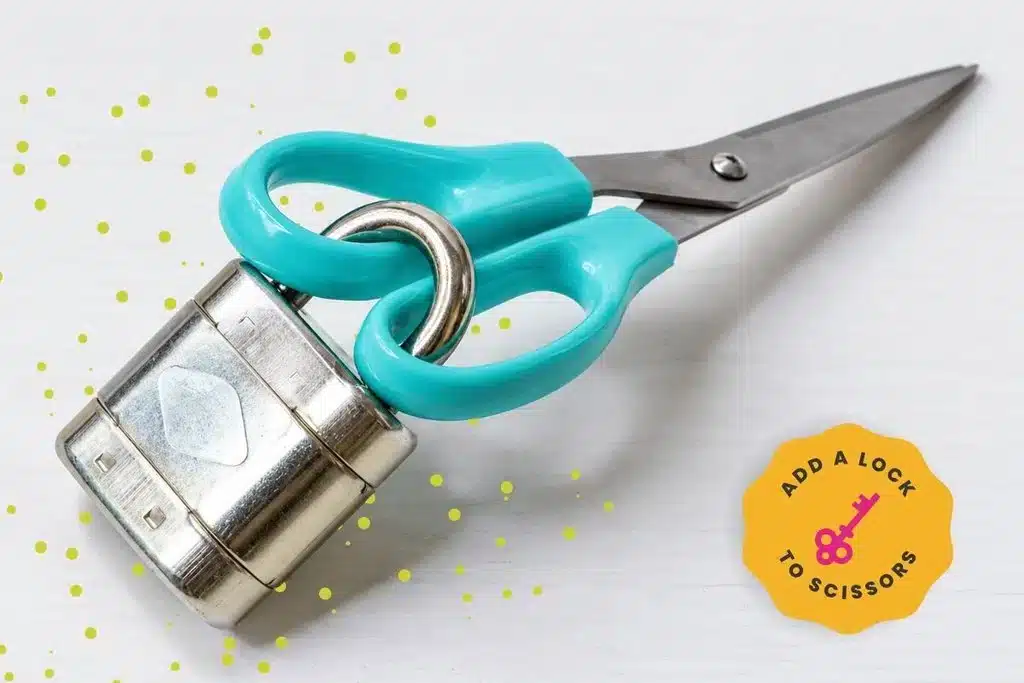
Different lock types give different vibes. A key lock feels traditional, and you can hide the key in other objects inside your escape room. A word lock lets you hide a password inside another clue. A directional lock works really nicely when you’ve hidden arrows somewhere in the room, or you hint at the combination using a short poem or story with directions hidden in it.
The lovely thing about locks is that they add a physical task to the mental puzzles. They’re tactile, and opening one feels like real progress.
3. UV Light and Invisible Ink Clues
There’s something delightfully dramatic about revealing a hidden message with a blacklight. It feels like the start of a spy film but in your living room. I tend to write clues in UV pen and hide the blacklight torch somewhere nearby. The moment of discovery is part of the fun.

If you’re feeling extra creative, the hidden message can be coded itself. Two layers of mystery for the price of one. This works beautifully in spy, or secret-mission themed rooms. In the puzzle below I’ve written a coded message where numbers represent letters on a keypad using my UV pen.
4. Heat Reveal Secret Messages
Frixion pens are a favourite of mine when creating escape room puzzles. Write your message using a regular pen, then disguise it with symbols or scribbles using a Frixion pen. When you apply gentle heat, the Frixion ink disappears, revealing the message underneath.
The first time I tried this, the reaction was priceless! The symbols covering my message vanished right in front of the kids, and they loved it.
I’ve experimented with different colours, but I find black works best for hiding the message.
I used a long-handled safety lighter for the clue reveal because the disappearing-ink moment feels extra exciting when there’s a little bit of theatrics behind it.
The key here is supervision if you are using this with kids. The kids were right beside me, we talked about how to hold it safely, and they only handled it while I was there providing supervision. Use your judgement
If you’d prefer not to use a safety lighter, you can get the same reveal using a hairdryer or craft heat gun on a low setting, which works beautifully and keeps things nice and controlled. My kids absolutely loved this message reveal. I highly recommend that you try this one out.
5. Red Acetate Secret Message Puzzle
You will need some red acetate for this escape room idea. I’ve experimented with clear acetate that I coloured in, and it works, but the ink took a fair while to dry; that was probably because of the type of felt-tip pen I used. I ended up buying some red acetate from Amazon.
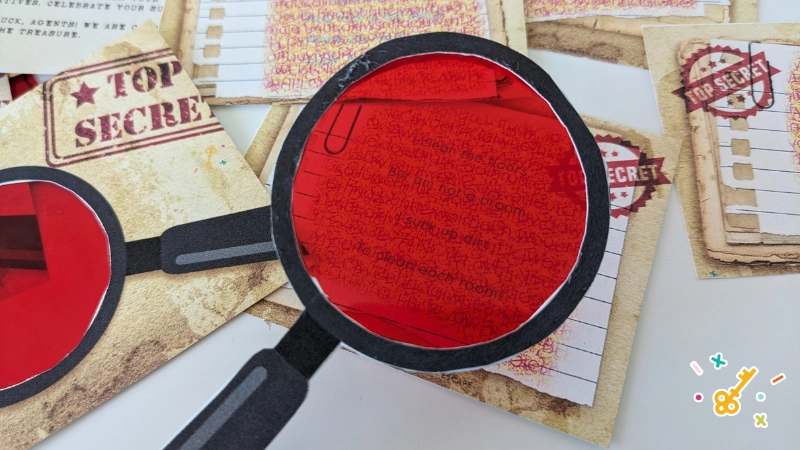
If you love this idea, why not take a look at my ready-to-print spy treasure hunt game that uses this exact method!
You’re going to want to grab yourself a blue pen to write your message or draw your picture. Then use different shades of red to draw all over your message. The aim is to disguise the blue ink. To reveal your message, lay the red acetate over the top, and voila, the blue text suddenly becomes clearer. I love how simple but effective this is.
6. Wax Resist Hidden Messages
Use wax crayons and a paint resist technique to reveal hidden messages. A white crayon, white paper, and some paint is all you need for this one. The message stays invisible until the paint goes over it. The clue appears slowly and feels quite magical, even though the setup takes almost no time at all.
7. First Letter Secret Code!
Ok, this could sound more exciting, but I promise it is a fun idea. Write what looks like a normal paragraph or list (great for younger players), but the real message is hidden in the first letter of each sentence.
Once players notice the trick, they feel like professional puzzle-solvers. I have highlighted the first letters of each sentence in the example so you can see. You can get ChatGPT to help you create your message.

If you’d like this puzzle idea but want to make it more challenging, try this: write your clue text as normal, but decide which letters you want to secretly highlight. Use uppercase letters in the middle of words, or switch a few to a different colour, or make them italic while everything else stays plain.
The hidden message will be there, waiting to be noticed. It’s the sort of puzzle that looks completely ordinary until the players realise something is “not quite right.” And you’ll be pleased to know it costs nothing except a bit of creative faffing around on your part.
8. Balloon Escape Room Clues
Not everyone likes balloons, but I love including them in my kids escape rooms and treasure hunts. I will often hide clues inside the balloons. The kids pop the balloons to retrieve the clues hidden inside.
Not everyone likes the noise of popping balloons, so here is a fun alternative. Use coloured balloons to match a code or pattern found in your game. Write numbers or letters on them and players sort into the correct order to reveal a word, phrase, or number.

Here is an example of how to use balloons. The players found a clue that read, “If a key is what you’re after, floating gently in the air, seek the green, the blue, the purple, and you’ll find it waiting there”. The order of those balloons spells the word hat; the other letters were just decoys. Players then found the key they needed hidden inside a hat.
9. Secret Codes and Cipher Puzzles
Using different codes is a must for your game. If you are feeling creative, create your very own secret code. Creating your code is an excellent way to personalise your escape game. For example, in a dinosaur-themed escape room, use pictures of different dinosaurs to represent each letter of the alphabet. Use your codes to write clues and reveal important information. Here is a list below of some simple codes you can include.
- Caesar Shift Cipher
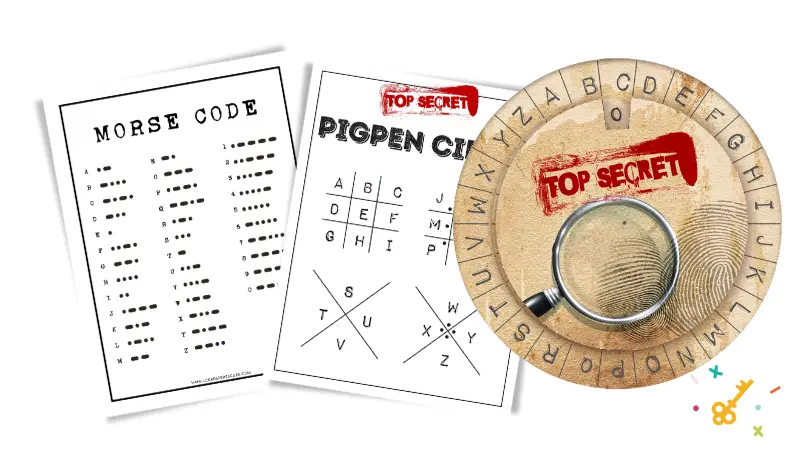
- Cipher Wheel Free Printable Escape Room Cipher Wheel Want to create your own secret messages? Grab my free printable cipher wheel and have fun writing coded clues for your players to crack. It’s an easy way to add an extra puzzle to your DIY escape room.
- Pigpen Cipher – I love this cipher, it looks tricky but is actually super simple. Each letter is represented by a grid. I have a whole pigpen cipher blog post that includes a free printable kit enabling you to make some pigpen messages, give it a go.
- Morse Code – This can be used as an audio or visual clue. I have tried using morse code audio clues in kids’ games but generally they cant keep quiet long enough to hear it properly, so now I just use the dits and dahs as visual clues. I have a free Morse code activity pack available if you want to give that a go.
- Semaphore Flags
- Atbash Cipher – A simple substitution cipher where each letter of the alphabet becomes reversed. A becomes Z, B becomes Y, etc.
- Number-to-Letter Code (A=1, B=2, etc.)
- Skip Code (read every 2nd or 3rd letter)
- Symbol Substitution Code
- Polybius Grid (letters placed on a grid to locate)
- Braille
Want even more ideas on how to use codes? Take a look at my secret codes for escape rooms guide, where you’ll find more ways to create coded clues for your games. These can really make your games pop.
10. Recordable Audio Clues
I purchased a set of recordable buttons from Amazon, and they came in lots of different colours. They are usually sold for pets learning to “say” things; however, they are an excellent addition to a DIY escape room.
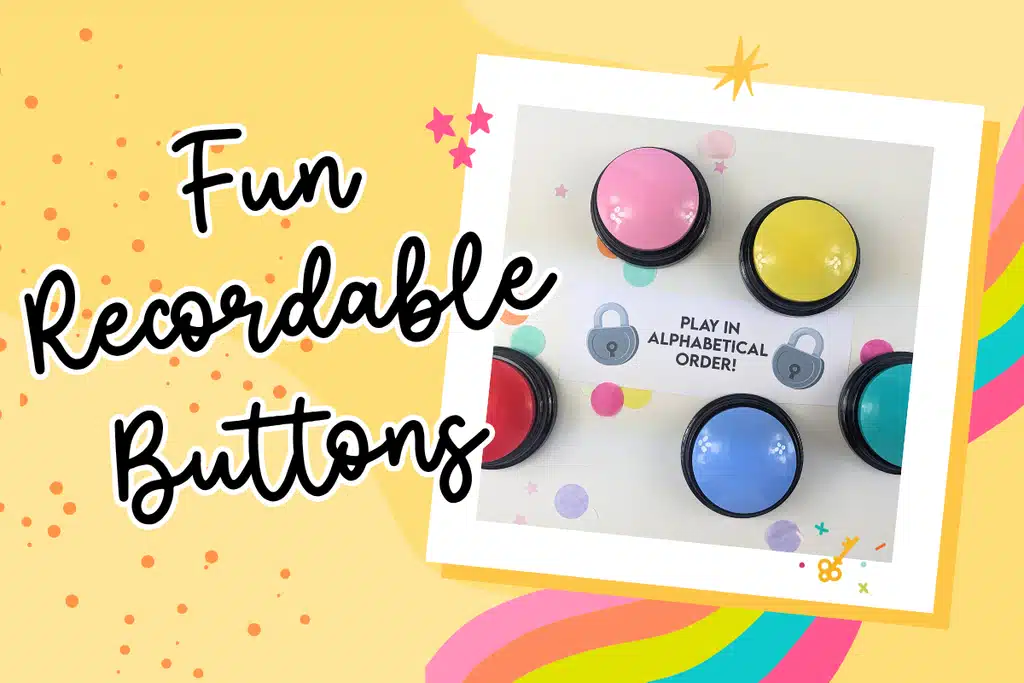
You can record single words, riddles, or sound hints. You can leave a clue for players to press them in a certain order, and then you are adding another sense into your game as the solution becomes auditory instead of visual.
11. Book Cipher Escape Room Puzzle
There’s something very satisfying about being told to “go to page 68, line 9, word 3.” It feels like real codebreaking. This works with novels, diaries, letters, even printed instructions you’ve designed yourself. To make it extra immersive, choose a book that matches the theme.
You can do the same with just a single page of text. Go through the page picking out letters that spell out your code word. Then, in order, write down the Line, Word and then Letter number for each letter that you need.
12. Paper Overlay Reveal Puzzle
Overlay puzzles are a lot of fun to include in your kids escape room. Use them to reveal information from a piece of text. A letter complementing your theme or a fake newspaper page would work.
Then, using a piece of card or paper, cut out holes revealing the text you want players to read. This is super simple to do. Up the difficulty level and cut the overlay into pieces that must be assembled first.

13. Mirror Message Puzzle
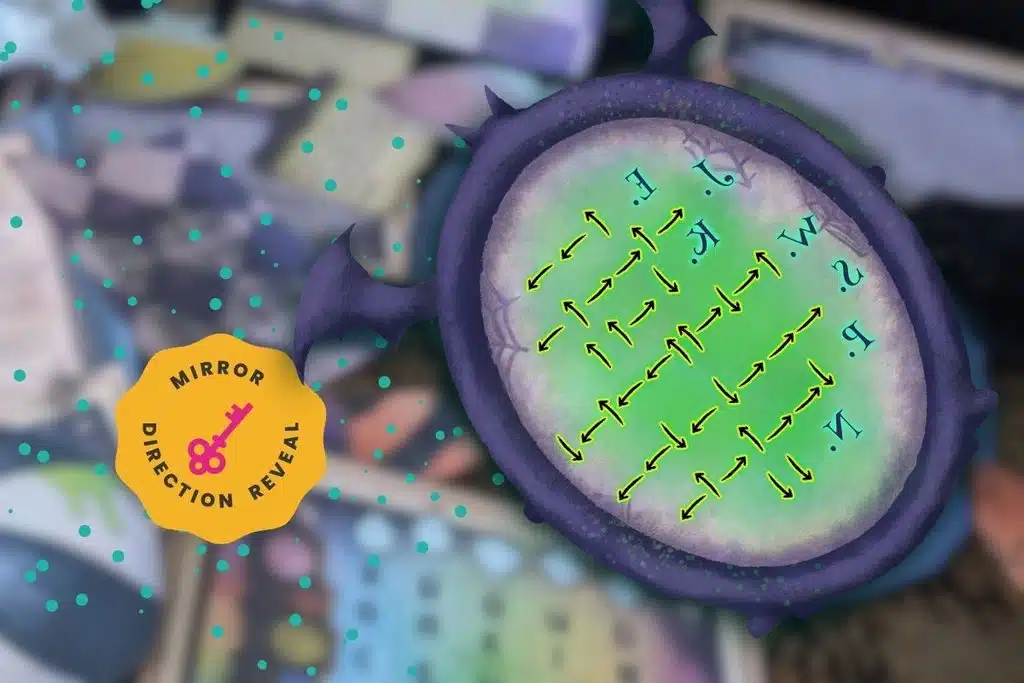
Write a message backwards and players need a mirror to read it. Or place a clue where it can only be seen in a reflection. This puzzle has a lovely “Oh!” moment when noticed. It encourages players to pay attention to their surroundings, which is one of the joys of escape rooms in the first place.
Bringing It All Together
Escape rooms are about discovery. The puzzles don’t need to be complicated, just thoughtful and connected to your theme. With just a handful of ideas like the ones above, you can create a game your family will talk about afterwards.
And if you do want to skip the planning stage entirely, I create printable escape room games that are ready to play. They include setup instructions, story, puzzles, props, and everything laid out for you. Perfect for family nights and birthdays when you want the fun without the prep.
You can explore them here: Kid Escape Room Games
Let’s stay connected!
Love this? Make sure to connect on your favorite social platform below for even more fun and games!
Zombie Escape Room
The zombies are on the loose. Will Dr Pepper become a zombie, and will you survive long enough to save the world? Do you have what it takes to find a way to escape before the zombies get you? Try our fab family Zombie escape game!